Showing posts with label Smoothies. Show all posts

I'll have my smoothie to go, please: necessity is the mother of invention

Wednesday, July 13, 2011

I have one of those pesky day-job things. Now, I actually do LOVE my job, but the major drawback of schlepping there every day is that it takes me out of the house and away from my beloved kitchen. So how do I cope? I make a transportable smoothie that I can blend in the quasi-functional blender at work. How does one do that?

You take a cloth napkin, spread it on the counter.
Add your little bed of greens (here I have organic spinach and some weird reddish stuff we grew in our community garden).

Then you add your fruit which today is an organic pear...

...then throw on some fresh herbs (curly parsley today) and a peeled lemon...

...then you change your mind (okay maybe that's just me) and add another piece of fruit. I added a green organic granny smith apple...

...then some kind of fun little "extra"- today it was ground flax seeds (you could also just keep these separate to avoid the inevitable mess it makes when it sticks to the napkin...whatever). :)

Wrap up that little bundle of goodness like a burrito...


...then slip it into a ziplock bag that you can reuse over and over again...


The next morning, you unwrap the green goodness, toss it in said quasi-functional work blender (much to the chagrin of your coworkers who just LOVE the noise) with 1/2 cup of water and wrestle with the blender blend till as smooth as possible. Add a handful of ice, blend again and you have a delicious breakfast that will give you all the energy you need to get moving. Plus, even just at breakfast, you'll have had 5 or 6 servings of fruit and veggies. I'd wager that's more than most people get in a day and you're just getting started.

You have no idea how much happiness that little bag of goodness inspires in me. I love knowing I'm all set for the next morning.

Seeing these come out of the oven after my little burrito was tucked away also makes me super happy. My little wee lass turns four tomorrow and she will be thrilled to see these chocolate cupcakes ready to roll. 

Happy eating, folks!
Kirsten
Share/Bookmark

Part 2 of 2: Is juice healthy,even if it's 100% fruit? Answer: not by my standards

Friday, March 4, 2011


Okay. I promised I'd talk more about enzymes in part 2. Following part 1 where I broke down simple volume issues; namely, a large glass of OJ is like eating 3-4 oranges, but without the fiber and other nutrients to slow the release into the blood stream- as you would have if you simply ate the fruit).

I'll get to the pasteurization/enzyme question shortly, but first I wanted to point something out. Take for instance a popular bottled "mango smoothie" that has the following ingredients in it:

Mango puree (company claims that one entire mango is present per bottle), apple juice, water, orange juice, banana puree, coconut and lemon juice.

The bottle is 450mL. The serving size on the side of the bottle is almost 1/2 that- 250mL.

Now. Let's look at the nutritional info.

Serving size
Calories
Protein
Sugar
Fiber
Vitamin C
Vitamin A
Iron
Calcium
240mL
150
1g
30g
0g
O%
0%
2%
2%
450mL
281
1.8g
56g
0g
0%
0%
3.75%
3.75%

So what would happen if we simply blended the raw ingredients together?
Ingredient
Calories
Protein
Sugar
Fiber
Vitamin C
Vitamin A
Iron
Calcium
1 mango
107
1g
24g
3g
76%
25%
1%
2%
¼ orange
17.5
¼ g
4g
1g
32%
2%
¼%
2%
¼ banana
25
0g
3g
1g
4%
3%
3%
1%
1 wedge lemon
1
0g
0g
0g
4%
0%
0%
0%
½  oz coconut
50
1/2g
1g
1.5g
2%
0%
2%
0%
Totals:
200
1.75g
32g
6.5g
118%
30%
6%
5%

You'll notice I've bolded both the 250mL serving size and my calculated "smoothie" to illustrate a point, while trying to compare as closely as possible, the servings. Calories are roughly the same, sugars are roughly the same, but what do you notice in the other columns??? Where did the fiber go? In the trash. Where the heck did all the vitamins go????? I have a theory...

Pasteurization, my friends.

Okay. So as I mentioned yesterday, when you heat food (fruit, veggies, nuts, oils) you change them. The longer and hotter you cook something, the less will remain of the nutrients. Anything over 118 degrees Fahrenheit will cause damage to existing nutrients. Does this mean you should become a raw foodist and never cook anything again? Depends- does that appeal to you? If it doesn't, you may fit into my camp where I recognize that raw is the optimal way to go, and as a result I incorporate TONS of raw fruit and veggies into my diet (usually breakfast and lunch) but I still have cooked veggies at dinner...because come on- roasted brussel's sprouts are the best side dish ever invented. Period. Hands down. Full stop.

That being said however, recognize that when you heat your food, you will lose nutrients, so do so lightly (and for goodness sake don't microwave your food), and make up for it with raw at other points throughout the day.

In addition to the loss of vitamins and nutrients in pasteurized juice, there's this pesky thing about enzymes. Now, for any moms out there who have either breastfed or read up on it, EVERY available information source (WITHOUT EXCEPTION) will tell you not to microwave breast milk. The reason is that microwaving, or heating excessively (anything more than plopping the bottle into a bowl of warm water) will damage the incredible properties such as the immune boosters, vitamins/minerals and...wait for it...digestive enzymes. Breast milk isn't the only food that has naturally occurring enzymes- in fact, I'd be hard pressed to find a single living thing that did NOT have them.

So what the heck IS an enzyme? Please bare with me while I try to explain how I understand all this...I expect that if I've got this all turned around someone will jump in.

Let's go back to grade 9 science, shall we? An enzyme is a facilitator for all kinds of chemical reactions which enables the reaction to happen faster and more efficiently (requiring less energy). Enzymes are responsible for anything from the transformation of milk to cheese, to the transformation of barley to beer. There are also thousands of enzymes involved in the digestive process (ones that our body produces) as there are also thousands of enzymes that facilitate the chemical processes for any living thing we eat, to have grown and been alive. In other words, all living things produce their own enzymes. When you eat food that is alive, you ingest those enzymes also, which further ease your own digestion. When you cook your food, you are ingesting food that does not bring its own digestive powers, so you're on the hook for the whole enchilada (literally or figuratively...).

Again, I'm sorry to all the hard-core raw foodies out there, but I like warm food. I can't see myself as a hard-core raw foodist. However, we can minimize the detrimental effects of heat on our food by doing so minimally, or doing so with gusto recognizing that cooked and pasteurized food is lacking, and having a healthy balance of raw produce (for both the vitamins and minerals, as well as the healthy balance of enzymes). You might also try tricks like adding slivered veggies to warm broth or sauce rather than cooking chunks of veggies to soften them.

As I have said over and over: I am all about balance. I continue to have my little daily dose of dark chocolate, my plain potato chips and my roasted brussel's sprouts a few times a week because I don't ever want to feel deprived. And I don't. Feed your body well; crunch on raw veggies and fruit as much as you can, and pepper the rest of your diet with the other things you enjoy. Oh, and if you want juice, put fruit and ice in your blender. Your body will thank you.

Share/Bookmark

PART 1 of 2: Is juice healthy, even if it's 100% fruit? Hypothesis: no.

Saturday, February 26, 2011

So occasionally the boy really likes to do science experiments. He understands the states of matter, the three things it takes to make fire (air, heat, combustible for those of you who forget) and it inspired me to do my own experiment.

My friend Alyson at Proud to be a Fit Mom recently asked me if juice was bad, and why. I couldn't answer her so I did some research and an experiment.

Hypothesis: juice is a poor choice because you drink WAY more juice than you would ever eat of the actual fruits it came from...and probably other reasons as-yet-unknown to me. Let's see...

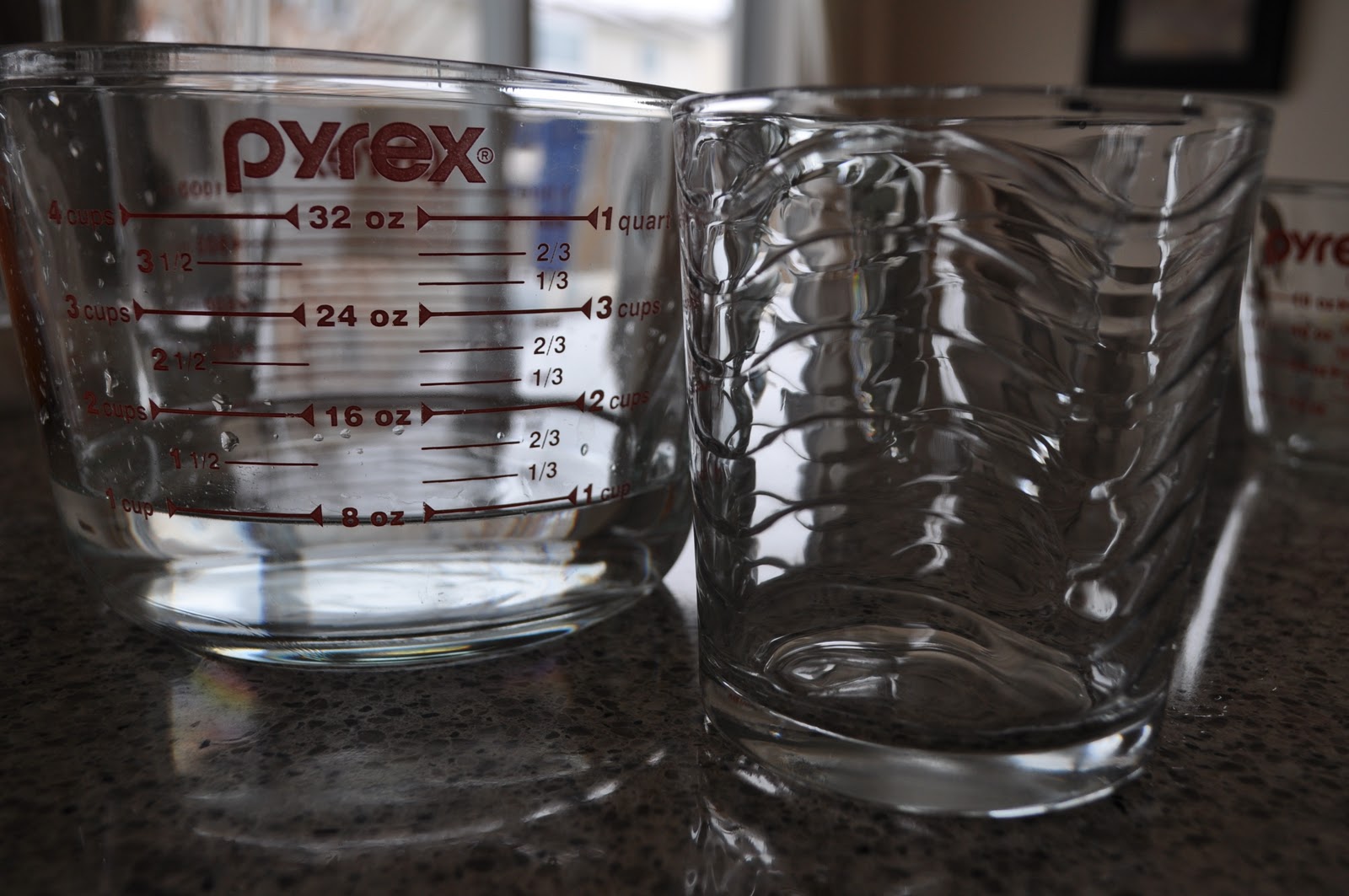
Here are the glasses available in my house (well, the main ones we use, anyway):

Big, medium and small

Big dude

Wide-mouth short dude

Small dude


Big dude comfortably holds 1 1/3 cups (comfortably meaning you wouldn't spill it walking to the table with it)


Middle dude (as this is reminiscent of the three bears, I will call him "momma bear") can hold 1 cup comfortably


And in that same vein, "baby bear" comfortably holds between 1/2 and 2/3 cup.


 This is a gorgeous organic orange that was super ripe and it produced between 1/3 and 1/2 cup orange juice. You will note that the pulp is sitting there...useless...when you simply juice it...more on that shortly.

Let's first discuss simple volume....If one orange produces roughly 3oz of juice, and you have the poppa bear of juice above, you'd be drinking the rough equivalent of 3 oranges. When the heck is the last time you sat down and ate 3 oranges? Ridiculous. 

Now...let's look at the nutritional information of one large orange (assuming you peeled it and ate it) vs. the nutritional info of the "cadillac" not-from-concentrate (NFC) bottled juice, and the average fast-food version:
Item
Calories
Sugar
Fiber
Calcium
Vitamin C
Iron
1 orange (which when squeezed, makes 3 oz OJ)
70
14g
7g
6%
130%
2%
3 oz regular NFC 
41
8.25g
0g
0.75%
45%
0%
Regular serving size NFC in our house
164
33g
0g
3%
180%
0%
Regular fast-food serving size (FC) (440mL)
210
44g
0g
0g
260%
0g
Regular bottle of NFC (500mL)
220
51g
0g
4%
190%
0%


Wow. I'm shocked. All this time I've excused 100% juice as "okay" without considering the volume, because it had "no added sugar" in it. Keep in mind, that although I'm guilty of sending a juice box for the boy in his lunch, any juice I pour for the kids is always 1/2 water, and I only drink juice maybe 1 time per week, but still, I had no idea.

When you consume that amount of fructose, without the fiber, iron and all the other lovelies that the factory threw out once it had squashed the LIFE out of the fruit, there's nothing to ease the instant sugar rush. Where does that go? Right into the blood stream, big sugar rush, big insulin spike, then you feel low, and store that additional sugar as...(drum roll please!!!) fat. Yep, that's right: I said FAT. Even if you're not overweight, that rise and crash really stresses the pancreas which produces all the insulin you need to counteract all that sugar. That's why it gets tired and closes up shop in more and more folks nowadays; the result is a little thing called Type 2 diabetes.

For more on the process of how the body turns fructose into fat, watch this video. Yes. It's long...I know. But it's worth it.

Part 2- Pasteurized vs Raw

Now. Pasteurization. The granola munchers (of which I have a part-time membership) are always going on about enzymes. When you cook food (as you do when you pasteurize juice for an extended shelf life), you apparently not only kill the vitamins and minerals, but the enzymes too. What the heck is an enzyme and why does it matter? Part 2 of 2 to follow...hopefully tomorrow but don't quote me on that. :)

Meanwhile, what did I do with that juice from this morning? I put the pulp, the juice and some ice into the blender. The result? Frothy, icy, heavenly, with bright flavour and rich texture...like sunshine in a glass. Don't believe me? Try it; peel an orange, drop it in the blender with 3 ice cubes and give it a wazz. You'll love it. 



Share/Bookmark

Appetizer recipe: Salmon cakes (gluten & dairy free)

Sunday, January 9, 2011

Happy New Year everyone! I hope everyone is off to a great, healthy start in 2011.

Over the holidays, I had two occasions to host gatherings at our house, and I came up with these little bite-sized jobbies to share with friends, and also to make sure I'd have something to munch on that would take the edge off before dinner. As much as I enjoy a veggie plate, it is kind of sad when that's your only option at a get-together. I wanted to have something more substantial.

These do take a while to make (maybe an hour start to finish), but the recipe will make a lot and your guests (or family!) will love them. Here's how I made it.

Salmon Cakes (gluten and dairy free)

Ingredients
2 large RUSSET POTATOES
2 stalks CELERY
1/4 ONION
2 cans SOCKEYE SALMON (pick the skin out but keep the bones for ++ calcium)
2 tbsp DIJON
1 tsp dried DILL
1 EGG (sub flax/water or chia seeds if you are not into eggs)
1/3 cup GLUTEN FREE BREAD CRUMBS (sub ground crackers, croutons etc.)
2 tbsp CAPERS
1/4 LEMON (juiced)
1/2 cup QUINOA FLAKES (optional)

Directions
1- Chop potatoes with skin on and set on stove to boil until tender (note: if you have leftover mashed potatoes, this would be a great way to use them up).
2- Meanwhile, to your food processor, add the celery and onion and grind. Then add these ingredients: salmon, Dijon, dill, egg, bread crumbs and lemon.
3- Empty your food processor into a bowl to make room for grinding the potatoes.
4- Once the potatoes have stopped cooking, you'll want to drain them and cool them down a bit. Once they're not so steamy (we don't want them to cook the egg in the mix on contact) put them in the food processor and give 'em a wazzz. You don't want it to be smooth- this dish is a bit more rustic, and chunky potatoes work well.
5- At this point, you should pre-heat your oven to 400 degrees Fahrenheit.
5- Add the contents of the bowl back in plus the capers and give it a final mix.
6- If you have quinoa flakes, sprinkle some on a plate and as you grab small handfuls (think golf-ball size) roll them in the flakes, then press them down on parchment paper on a cookie sheet to make small "discs".
7- Bake at 400 for 20 minutes, flipping at 15 minutes or whenever they've solidified a bit (if you flip them too early they'll fall apart). When you take them out of the oven, give them a minute before transferring to a plate as they may still be fragile while they're super hot.

Serve them with a garlic style dressing for dip. I highly recommend the Spunky Coconut's Italian dressing which is gluten and dairy free also and really REALLY yummy.

Before you go, have a look at today's smoothie- SUPER yum... (kale, spinach, parsley, coriander, mint, cashews, lemon and chia)
Enjoy and take care everyone!
Share/Bookmark

What should I buy if I want to drink smoothies? Dropsie's basic smoothie kit

Friday, December 31, 2010

In my last post, I mentioned that if changing the way you eat seems too daunting, you might instead try adding something healthy instead of thinking about all the things you should remove. Starting your day with a smoothie is a great way of giving you a boost of fiber, protein, calcium, vitamins and minerals. Plus, if you're like Mr. Pick-it-Up, you will embrace smoothies because they are made in ONE container (your blender) and don't require heaps of clean up. :)

I wanted to put together a shopping list for anyone who wants to add smoothies without investing too much.

1- You'll need a decent blender- that's first and foremost. You can get away with a Magic Bullet ($30-$40 range) as a first step if you're not keen on investing. At the expensive end of the scale, you have the Vitamix and Blendtech which both run around $500. Santa just brought me KitchenAid KSB560ER 5-Speed Blender with Polycarbonate Jar, Empire Red which of course, now that we HAVE it, is on sale at Amazon. I am LOVING it. My smoothies are like silk, as opposed to the Hamilton Beach model I used to use that required me to chew the bits in my smoothies. It DID however, get me hooked on them, so I invested...I mean, SANTA did, in the Kitchen Aid model. Plus it's red...like a cherry on top...and it's shiny...and I'm a girly girl, so I like it.  :)

Unless you have a pretty good blender, you may also want a coffee grinder to grind the seeds before you add them. Seeds in their whole form typically are not absorbed, so you'll want to make sure they're ground. Something like this will work fine (also works well for spices). Proctor Silex E160B Fresh Grind Coffee Grinder, White You don't need to shell out a lot of money on it.

2- Stock up on a few key dried goods. Bulk food places are evolving and starting to include things like raw nuts and other non-GMO organic foods. Start with your local bulk foods place, or if you prefer, you can stock up from someplace online.

Here are the things you're going to want to start with. There are a million ingredients, but I'm suggesting those with the biggest impact and the most nutrient density, without sending you on a wild goose chase for ingredients in the four corners of the globe... Note: keep all seeds and nuts in the fridge to keep them from going rancid.

  • Chia seeds
  • Flax seeds
  • Sesame seeds
  • Raw cashews
  • Raw almonds
  • Raw cacao
  • Coconut milk (freeze this in ice cube trays)

Here are a few links to online versions:
Navitas Naturals Chia Seeds Aztec Superfood, 16 Ounce Pouch
Bob's Red Mill Organic Flaxseed Meal, 16-Ounce Packages (Pack of 4)
Frontier Sesame Seed, Natural, Whole Certified Organic, 16 Ounce Bags (Pack of 2)
Navitas Naturals Really Raw Cashews, 16-Ounce Pouch (Pack of 2)
Natural Raw Almonds (4 Pound Bag)
Certified Organic, Raw Cacao Powder, From Peru 1#
Native Forest Organic Classic Coconut Milk, 13.5-Ounce Cans (Pack of 12)

3- Hit the grocery store! Whenever possible, choose organic ingredients- particularly when you're talking about greens because they are among the most pesticide-ridden produce. Things with thick peels like lemons, bananas and avocados don't necessarily need to be organic if you're on a budget.

Here's your basic list:

  • Parsley
  • Mint
  • Coriander
  • Kale and/or Swiss chard
  • Romaine
  • Spinach
  • Green and/or red apples
  • Bananas (peel, chop in chunks and keep frozen)
  • Lemons


4- Now figure out your favourite recipes! You can search for "green smoothies" through Google and come up with thousands of options. Shan Larter has some of my favourite recipes so be sure to check her out too. This tropical banana mint madness smoothie is one of my favourites but lately I've been doing mostly greens, seeds, nuts and lemons. They are sooo refreshing and tart. Love 'em!

As you become more comfortable with the concept of blending and melding flavours, I'm sure you'll come up with your own options with new and exciting ingredients. If you have a favourite to share, please post your own smoothie recipes in the comments section below!

Happy New Year everyone. May it be a time of renewal, health and happiness. :)
Share/Bookmark

Top ten considerations when making a weight-related New Years resolution- Are you planning to lose weight in 2011?

Sunday, December 26, 2010

So Christmas has come and gone, and I hope you had a tremendous time with your most beloved friends and families. The new year brings (for many) renewed vigour and hope for change in 2011. You may be like so many who will decide that enough is enough- this is the year they will FINALLY diet successfully. They will vow that they will suffer, cut, avoid, and otherwise deprive themselves in an effort to finally fit into their clothes, or be some magic number on the scale, or perhaps a more clinical goal of normalizing blood sugar levels, getting cholesterol into healthy ranges, or bringing down their blood pressure. So fueled by that vigour, folks go searching for something they can use, a tool, some kind of framework they can fit into, where someone can tell them concretely what they can do to achieve their goal. I have some thoughts on this one..I wanted to share them with you.

Top ten considerations when making a weight-related New Years resolution

  1. Are you ready to permanently change your habits?  If you think you can do "something" for a few months, achieve your goal and happily return to what you're doing now, you can't. Sorry. What you're doing now is not working or you wouldn't be considering a change, would you?
  2. Are you ready to be in the driver's seat regarding your health and to learn about nutrition? If you are looking for someone who will just tell you what to do, I have a secret to tell you: that person cannot follow you around for the rest of your life. You need to be aware of what you're putting in your mouth, and what the repercussions are or you will fail. Full stop.
  3. Are you ready to challenge conventional dietary "wisdom", what "big food" is selling as healthy, and accept that what you have traditionally eaten won't work anymore? Milk, it does a body good. Really? Does it? This is a slogan from an advertising campaign; it is not a fact. Milk causes mucus, calcium LOSS, an assault on the immune system and plain old ILLNESS. These and other truths will surprise you as you learn how ensconced the dairy industry, big food, and other farming industries (corn, wheat, soy) are in what you are told and what you then believe. Also, getting used to the fact that fat doesn't make you fat, but instead sugar and refined carbohydrates do, is a tough thing to get used to after decades of eating "low fat". You'll have to talk yourself through that fallacy and others over and over until they finally sink in.
  4. Will you accept that once you change and make healthy choices, the people around you won't be comfortable eating with you anymore? Like-minded people hang in packs. In a study spanning over 30 years researchers discovered that one's chance of becoming obese or overweight increased exponentially when overweight/obese people were in one's social circle. So the next time your pals want to go schlopp down the next saturated fat/salt/sugar fest at some fast food restaurant, you are going to rock the boat when you decide you're not eating that garbage anymore. One of two things might happen: 1)[la-la land] your friends will thank you for introducing them to a new way of eating, or 2) [more likely] they'll get tired of listening to you and your healthy ways (and the way you make them feel guilty for abusing their own bodies), and you might have to find a new pack of like-minded folks to go to lunch with. 
  5. Are you willing to suffer withdrawal? Yes, food is addictive- both physically and emotionally. Ask anyone who has decided to give up sugar what happens when they do...it's not pretty. It hurts. Your head will throb and you'll suspect your enemies of buying a voodoo doll of you and stabbing your eye sockets repeatedly with pins. I promise that it's worth it, and it only lasts a few days, but I can't lie to you and tell you that it won't be uncomfortable.
  6. Can you envision creating new social experiences? So much of what we do is centred around food. We feast together for any number of reasons. Can you accept that those may not be available to you anymore, and can you imagine getting out there and creating new ways of just being with people?
  7. Can you give up foods that make you feel poorly forever? When you immune system is taxed by foods that make you tired, bloated and constipated, it thrives when you cut those foods out. The most allergenic foods include dairy, wheat, corn and soy. Once you give those up, you can rarely "go back" as the reactions that kept you feeling crappy most of the time will now make you feel terrible. 
  8. Are you ready to get creative with your budget? Non-conventional meats are more expensive (think happy animals not pumped full of antibiotics with room to move around) as are organic fruit and vegetables. These changes will yield incredible results, but certainly a meal will start being more expensive. The cost is not unmanageable for most, as boxed and packaged foods are eating up more of your grocery budget than you could imagine (as are crappy restaurant meals) but you'll have to do some meal planning to manage the costs.
  9. Can you make time for preparation? If you prepare foods in advance (like chopping a whole bunch of veggies in anticipation of a week's worth of lunches and snacks) you can ensure you have healthy choices on hand for when you get hungry and you're not reaching for the phone to call for a pizza.
  10. Ready to read labels? You're going to have to look at packaged foods and figure out what is and is not a healthy choice for you and your family. Things like "enriched wheat flour", sugar (think any ingredient that ends in "ose"- fructose, glucose, lactose, etc), hydrogenated oils, soy derivatives and other non-foods can sneak into everything you've eaten for years. You'll have to begin asking yourself if the foods you reach for are indeed helpful and healthy. Chances are that if it comes from a box, bag, can or package, you'll find all kinds of health saboteurs ready to spoil all your hard work. Be vigilant!
I wish you all the best in 2011, and I'll be kicking around to keep on tackling the hard food questions and providing recipes along with many other bloggers out there whose recipes I use to create yummy, healthy, satisfying meals for our family. It might seem like a lot to take in all at once, but start off by adding healthy options rather than eliminating poor ones off the hop- it may help soften the blow. Plus eventually those healthy choices grow, and you'll crowd out all the poor choices you once made. Then, my friends, you will reap the benefits on the road to a stronger, livelier and leaner you.

Who's ready? I say bring...it...on!!!!


Share/Bookmark

Healthy food, healthy mind, healthy me Copyright © 2009 Designed by Ipietoon Blogger Template for Bie Blogger Template Vector by DaPino