Showing posts with label Healthy living. Show all posts

I'll have my smoothie to go, please: necessity is the mother of invention

Wednesday, July 13, 2011

I have one of those pesky day-job things. Now, I actually do LOVE my job, but the major drawback of schlepping there every day is that it takes me out of the house and away from my beloved kitchen. So how do I cope? I make a transportable smoothie that I can blend in the quasi-functional blender at work. How does one do that?

You take a cloth napkin, spread it on the counter.
Add your little bed of greens (here I have organic spinach and some weird reddish stuff we grew in our community garden).

Then you add your fruit which today is an organic pear...

...then throw on some fresh herbs (curly parsley today) and a peeled lemon...

...then you change your mind (okay maybe that's just me) and add another piece of fruit. I added a green organic granny smith apple...

...then some kind of fun little "extra"- today it was ground flax seeds (you could also just keep these separate to avoid the inevitable mess it makes when it sticks to the napkin...whatever). :)

Wrap up that little bundle of goodness like a burrito...


...then slip it into a ziplock bag that you can reuse over and over again...


The next morning, you unwrap the green goodness, toss it in said quasi-functional work blender (much to the chagrin of your coworkers who just LOVE the noise) with 1/2 cup of water and wrestle with the blender blend till as smooth as possible. Add a handful of ice, blend again and you have a delicious breakfast that will give you all the energy you need to get moving. Plus, even just at breakfast, you'll have had 5 or 6 servings of fruit and veggies. I'd wager that's more than most people get in a day and you're just getting started.

You have no idea how much happiness that little bag of goodness inspires in me. I love knowing I'm all set for the next morning.

Seeing these come out of the oven after my little burrito was tucked away also makes me super happy. My little wee lass turns four tomorrow and she will be thrilled to see these chocolate cupcakes ready to roll. 

Happy eating, folks!
Kirsten
Share/Bookmark

Parents: don't give up and accept your kids' poor food choices

Saturday, April 23, 2011

I'm sure I've said this before, but I'll say it again: no matter where you're starting from, you can encourage a change in your child's eating habits. Even if you feed your children everything out of a can, bag, or package, even if your children are on a steady diet of hot dogs and chicken fingers, don't think you can't inspire and create change in them.

My little guy has always been a good eater. That kid could barely say "more" (actually it was like "moh! moh!") when he would demand bbq'd vegetables until he was stuffed full. He's always been pretty easy to negotiate with. He understands the concept of balance now too- in order to be allowed to have treats, first, we eat lots of fresh fruit and veggies. THEN we can have treats. My wee lass, on the other hand, has been tougher. For a long time, she just didn't like fruit and veggies. But after years of sticking with it, she is finally turning the corner. As a matter of fact, I was just blending a green smoothie and before I had even instituted my usual trick of adding blueberries to cover up the look of the greens (parsley in this case) she was asking for a taste. Amazing.

In addition to not giving up, and always offering healthy choices -- even if you think they won't eat it -- I have only one additional piece of advice from someone far more eloquent than I:
"Be the change you want to see in the world." 
Mahatma Ghandi

You simply cannot inspire your children to be healthy, eat healthy and care about achieving their own balance, if you are not leading them. "Do what I say, but not what I do" will never work. Eat with them, show them you're committed, and keep trying.

Recently, a Twitter friend asked if anyone had any great successes in inspiring their kids' food choices. I'll ask the same: what healthy food have you encouraged and been successful in getting YOUR kids to eat? No success is too small. It's your turn to pat yourself on the back. Anyone want to share? (recipes also welcome) :)
Share/Bookmark

Part 2 of 2: Is juice healthy,even if it's 100% fruit? Answer: not by my standards

Friday, March 4, 2011


Okay. I promised I'd talk more about enzymes in part 2. Following part 1 where I broke down simple volume issues; namely, a large glass of OJ is like eating 3-4 oranges, but without the fiber and other nutrients to slow the release into the blood stream- as you would have if you simply ate the fruit).

I'll get to the pasteurization/enzyme question shortly, but first I wanted to point something out. Take for instance a popular bottled "mango smoothie" that has the following ingredients in it:

Mango puree (company claims that one entire mango is present per bottle), apple juice, water, orange juice, banana puree, coconut and lemon juice.

The bottle is 450mL. The serving size on the side of the bottle is almost 1/2 that- 250mL.

Now. Let's look at the nutritional info.

Serving size
Calories
Protein
Sugar
Fiber
Vitamin C
Vitamin A
Iron
Calcium
240mL
150
1g
30g
0g
O%
0%
2%
2%
450mL
281
1.8g
56g
0g
0%
0%
3.75%
3.75%

So what would happen if we simply blended the raw ingredients together?
Ingredient
Calories
Protein
Sugar
Fiber
Vitamin C
Vitamin A
Iron
Calcium
1 mango
107
1g
24g
3g
76%
25%
1%
2%
¼ orange
17.5
¼ g
4g
1g
32%
2%
¼%
2%
¼ banana
25
0g
3g
1g
4%
3%
3%
1%
1 wedge lemon
1
0g
0g
0g
4%
0%
0%
0%
½  oz coconut
50
1/2g
1g
1.5g
2%
0%
2%
0%
Totals:
200
1.75g
32g
6.5g
118%
30%
6%
5%

You'll notice I've bolded both the 250mL serving size and my calculated "smoothie" to illustrate a point, while trying to compare as closely as possible, the servings. Calories are roughly the same, sugars are roughly the same, but what do you notice in the other columns??? Where did the fiber go? In the trash. Where the heck did all the vitamins go????? I have a theory...

Pasteurization, my friends.

Okay. So as I mentioned yesterday, when you heat food (fruit, veggies, nuts, oils) you change them. The longer and hotter you cook something, the less will remain of the nutrients. Anything over 118 degrees Fahrenheit will cause damage to existing nutrients. Does this mean you should become a raw foodist and never cook anything again? Depends- does that appeal to you? If it doesn't, you may fit into my camp where I recognize that raw is the optimal way to go, and as a result I incorporate TONS of raw fruit and veggies into my diet (usually breakfast and lunch) but I still have cooked veggies at dinner...because come on- roasted brussel's sprouts are the best side dish ever invented. Period. Hands down. Full stop.

That being said however, recognize that when you heat your food, you will lose nutrients, so do so lightly (and for goodness sake don't microwave your food), and make up for it with raw at other points throughout the day.

In addition to the loss of vitamins and nutrients in pasteurized juice, there's this pesky thing about enzymes. Now, for any moms out there who have either breastfed or read up on it, EVERY available information source (WITHOUT EXCEPTION) will tell you not to microwave breast milk. The reason is that microwaving, or heating excessively (anything more than plopping the bottle into a bowl of warm water) will damage the incredible properties such as the immune boosters, vitamins/minerals and...wait for it...digestive enzymes. Breast milk isn't the only food that has naturally occurring enzymes- in fact, I'd be hard pressed to find a single living thing that did NOT have them.

So what the heck IS an enzyme? Please bare with me while I try to explain how I understand all this...I expect that if I've got this all turned around someone will jump in.

Let's go back to grade 9 science, shall we? An enzyme is a facilitator for all kinds of chemical reactions which enables the reaction to happen faster and more efficiently (requiring less energy). Enzymes are responsible for anything from the transformation of milk to cheese, to the transformation of barley to beer. There are also thousands of enzymes involved in the digestive process (ones that our body produces) as there are also thousands of enzymes that facilitate the chemical processes for any living thing we eat, to have grown and been alive. In other words, all living things produce their own enzymes. When you eat food that is alive, you ingest those enzymes also, which further ease your own digestion. When you cook your food, you are ingesting food that does not bring its own digestive powers, so you're on the hook for the whole enchilada (literally or figuratively...).

Again, I'm sorry to all the hard-core raw foodies out there, but I like warm food. I can't see myself as a hard-core raw foodist. However, we can minimize the detrimental effects of heat on our food by doing so minimally, or doing so with gusto recognizing that cooked and pasteurized food is lacking, and having a healthy balance of raw produce (for both the vitamins and minerals, as well as the healthy balance of enzymes). You might also try tricks like adding slivered veggies to warm broth or sauce rather than cooking chunks of veggies to soften them.

As I have said over and over: I am all about balance. I continue to have my little daily dose of dark chocolate, my plain potato chips and my roasted brussel's sprouts a few times a week because I don't ever want to feel deprived. And I don't. Feed your body well; crunch on raw veggies and fruit as much as you can, and pepper the rest of your diet with the other things you enjoy. Oh, and if you want juice, put fruit and ice in your blender. Your body will thank you.

Share/Bookmark

PART 1 of 2: Is juice healthy, even if it's 100% fruit? Hypothesis: no.

Saturday, February 26, 2011

So occasionally the boy really likes to do science experiments. He understands the states of matter, the three things it takes to make fire (air, heat, combustible for those of you who forget) and it inspired me to do my own experiment.

My friend Alyson at Proud to be a Fit Mom recently asked me if juice was bad, and why. I couldn't answer her so I did some research and an experiment.

Hypothesis: juice is a poor choice because you drink WAY more juice than you would ever eat of the actual fruits it came from...and probably other reasons as-yet-unknown to me. Let's see...

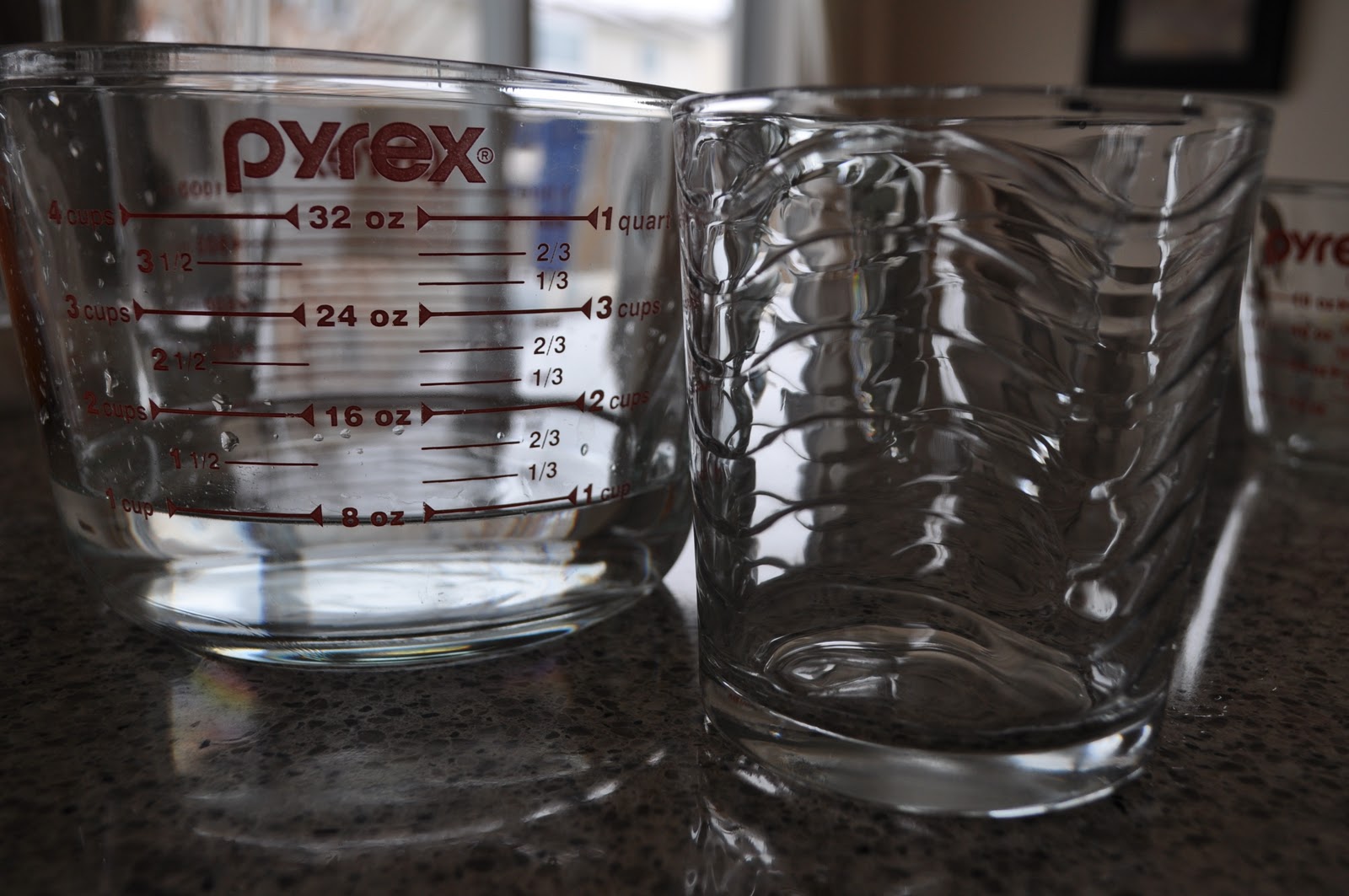
Here are the glasses available in my house (well, the main ones we use, anyway):

Big, medium and small

Big dude

Wide-mouth short dude

Small dude


Big dude comfortably holds 1 1/3 cups (comfortably meaning you wouldn't spill it walking to the table with it)


Middle dude (as this is reminiscent of the three bears, I will call him "momma bear") can hold 1 cup comfortably


And in that same vein, "baby bear" comfortably holds between 1/2 and 2/3 cup.


 This is a gorgeous organic orange that was super ripe and it produced between 1/3 and 1/2 cup orange juice. You will note that the pulp is sitting there...useless...when you simply juice it...more on that shortly.

Let's first discuss simple volume....If one orange produces roughly 3oz of juice, and you have the poppa bear of juice above, you'd be drinking the rough equivalent of 3 oranges. When the heck is the last time you sat down and ate 3 oranges? Ridiculous. 

Now...let's look at the nutritional information of one large orange (assuming you peeled it and ate it) vs. the nutritional info of the "cadillac" not-from-concentrate (NFC) bottled juice, and the average fast-food version:
Item
Calories
Sugar
Fiber
Calcium
Vitamin C
Iron
1 orange (which when squeezed, makes 3 oz OJ)
70
14g
7g
6%
130%
2%
3 oz regular NFC 
41
8.25g
0g
0.75%
45%
0%
Regular serving size NFC in our house
164
33g
0g
3%
180%
0%
Regular fast-food serving size (FC) (440mL)
210
44g
0g
0g
260%
0g
Regular bottle of NFC (500mL)
220
51g
0g
4%
190%
0%


Wow. I'm shocked. All this time I've excused 100% juice as "okay" without considering the volume, because it had "no added sugar" in it. Keep in mind, that although I'm guilty of sending a juice box for the boy in his lunch, any juice I pour for the kids is always 1/2 water, and I only drink juice maybe 1 time per week, but still, I had no idea.

When you consume that amount of fructose, without the fiber, iron and all the other lovelies that the factory threw out once it had squashed the LIFE out of the fruit, there's nothing to ease the instant sugar rush. Where does that go? Right into the blood stream, big sugar rush, big insulin spike, then you feel low, and store that additional sugar as...(drum roll please!!!) fat. Yep, that's right: I said FAT. Even if you're not overweight, that rise and crash really stresses the pancreas which produces all the insulin you need to counteract all that sugar. That's why it gets tired and closes up shop in more and more folks nowadays; the result is a little thing called Type 2 diabetes.

For more on the process of how the body turns fructose into fat, watch this video. Yes. It's long...I know. But it's worth it.

Part 2- Pasteurized vs Raw

Now. Pasteurization. The granola munchers (of which I have a part-time membership) are always going on about enzymes. When you cook food (as you do when you pasteurize juice for an extended shelf life), you apparently not only kill the vitamins and minerals, but the enzymes too. What the heck is an enzyme and why does it matter? Part 2 of 2 to follow...hopefully tomorrow but don't quote me on that. :)

Meanwhile, what did I do with that juice from this morning? I put the pulp, the juice and some ice into the blender. The result? Frothy, icy, heavenly, with bright flavour and rich texture...like sunshine in a glass. Don't believe me? Try it; peel an orange, drop it in the blender with 3 ice cubes and give it a wazz. You'll love it. 


Share/Bookmark

The Bitter Truth About Sugar- watch the video

Sunday, February 6, 2011

So, this weekend, I have done the amount of chopping, cooking and prepping that I usually do in a week. I'm kinda fried, to be honest. I have a lot of recipes in my noodle, but unfortunately, I am going to take a few more days to sort out exactly which worked, and which didn't!

Hope everyone is well, and I'll leave you with this. I believe that this is a med school lecture given by Robert H. Lustig, MD, UCSF Professor of Pediatrics in the division of Endocrinology. It's long...I get that...but if you can square away an hour and a half to watch it (think of it as movie night!!) you'll be very glad you did...

This video debunks the myths that:
1) eating fat causes fat;
2) eating fat causes heart disease;
3) that if you eat it, you better burn it or you're gonna store it (as fat)- MYTH!!
and proves the following:
4) sugar- particularly fructose (think high fructose corn syrup that is in almost EVERY processed food) - causes obesity.
4) drinking gatorade, pop (soda), and other sweetened beverages - INCLUDING FRUIT JUICE- in significant quantities makes you fat and ultimately has led to the obesity epidemic.


I really hope someone has some thoughts on this that they would like to share. The comments spot is open! :)

See you in a few days!
Kirsten
Share/Bookmark

Vegetable soup (simple, gluten free, dairy free)

Saturday, January 29, 2011

Hello all! With a sick lil' boy, I stretched my imagination and came up with a quick soup.
Here's the skinny on how I made soup in about 30 minutes (start to finish!):

Quick vegetable soup
Ingredients:
1 box Pacific natural foods organic chicken broth
1/2 cup Eden Organics pasta and pizza sauce
1/2 an onion, diced
1 Tb grapeseed oil
2 cups chopped veggies (mine included green beans, fresh peas, carrots, peppers)
3/4 cup brown rice pasta mini shells

Directions:
Saute onion in oil until translucent. Add the rest, bring to a boil and simmer until the noodles are soft. Yep. That's it. ;)

Kitchen tip: Every week I make a HUGE container of chopped veggies and leave it in the fridge to pilfer from for lunches, snacks, etc. That was one of the reasons this was so quick to make: I grabbed handfuls of carrot sticks, peppers etc. and gave them a quick dice. I strongly recommend you invest an hour to chop everything at the beginning of the week and keep it in a container like this Rubbermaid one- they will keep throughout the week (though you may want to lay a damp paper towel over the lot to keep them from drying out).
Share/Bookmark

What colour is YOUR dinner?

Tuesday, January 18, 2011

Remember when you were choosing your dinnerware? What is the perfect colour? What would go with your kitchen? What is the most versatile?
Well, it seems that for most people, the plate has become more important than what goes ON the plate...
Have a look at this:

 And remember this poor woman from the Jamie Oliver specials who was suffering both physically and emotionally? Check out what her week's worth of food looked like!

Notice anything? Brown. Beige. Ecru. Off-white. White.

This disgusting sea of nasty food is anemic...Where the heck is the colour???

Now have a peek at these:


Can you say YUUUMMMMMM!!!!!

Let the passion that you displayed in selecting your dinner plate, spill over to the selection of what goes on it. Choose your food for its bright, pleasing colours, and make sure you get a variety of colours in each meal. Colours and the brightness of those colours, is a pretty easy indication of how many varied nutrients are present in your food. Let your eyes, your sense of beauty, colour, composition, guide you as you construct your meal choices. Let's have a peek at exactly what the colours mean:

  • Orange/yellow foods (oranges, pineapple, tangerines, papaya) - Antioxidants like vitamin C: improve health of mucus membranes and connective tissue. Help prevent heart disease by improving circulation and preventing inflammation.
  • Orange (carrots, pumpkin, squash, sweet potatoes) - Lutein, which cannot be created in the body, beta carotene and vitamin A help eye health, promoting night vision and warding off cataracts 
  • Green (broccoli, kale, romaine, spinach)- A rich source of iron, calcium, potassium, magnesium, and vitamins K, C, E and many complex B vitamins-  powerful anti-cancer compounds. 
  • Red (tomatoes, watermelon, red cabbage)- Lycopene: anti-cancer, prevents prostate problems and reduces the effects of sun damage on the skin.
  • Blue/purple (red apples, beets, blueberries, strawberries, grapes)- Anthocyanins: powerful antioxidants that protect against heart disease by improving circulation and preventing blood clots. Also have anti-aging phytochemicals that help counteract the processed and trans-fat rich Standard American Diet (SAD...this is pretty ironic).
  • White/Green foods (onions, garlic, celery, pears, chives)- Allicin: Anti-viral, anti-bacterial, anti-fungal phytochemical. 
  • Yellow/Green foods (corn, green peas, collard greens, avocado, honeydew)- Lutein and zeaxanthin: help reduce degenerative eye conditions and the risk of osteoporosis. 
This is but a snapshot of what Mother Nature has to offer. So next time you sit down to a meal, check out the colours on your plate. If you're having a dinner that varies in shades of brown (we all have the odd french fries, chicken fingers, etc.), why not take ten seconds and cut up a red and green pepper to add some raw veggies to your meal. A treat doesn't have to mean a completely nutritionless meal- why not have that slice of pizza or chicken wings with a bright stir fry or salad? Your body will be very glad you did.


Share/Bookmark

Healthy food, healthy mind, healthy me Copyright © 2009 Designed by Ipietoon Blogger Template for Bie Blogger Template Vector by DaPino